

Colorado’s State of Homelessness Report 2025
Written and prepared by the four Continuums of Care, statewide agencies, and local providers.
Introduction
The 2025 State of Homelessness Report provides a comprehensive look at trends and data around homelessness in the State and how Colorado is responding to one of its most complex challenges. This year’s data reveals an effective statewide homelessness response system that is performing at a high level, reaching more people than ever before with the resources they need to find and maintain a home. With greater investment and support for the Colorado homeless response system, these impacts could significantly enhance and provide long-term homelessness resolution and prevention for all communities across Colorado.
Our findings confirm a singular truth: When appropriate housing and supports are available, the system succeeds. With an 82.1% housing retention rate—representing, as of year end, those who remained housed within programs or successfully exited to a permanent home, the evidence demonstrates that Colorado’s strategies are effective at ending the cycle of crisis for individuals and families.
This report moves beyond a traditional snapshot of homelessness to look at the entire spectrum of care—the coordinated network of providers and programs that support Coloradans before, during, and after a housing crisis. By understanding the full reach of these efforts, we can more effectively target the investments and interventions needed to ensure homelessness is rare, brief, and non-recurring.
Key Facts
Evidence of Success: 27,448 Coloradans reached long-term housing stability last year. This total represents individuals who received services to prevent losing their home, were stabilized in permanent housing, or successfully transitioned to a permanent home. These results demonstrate that when appropriate housing and supports are available, individuals stabilize and reduce their utilization of costly crisis services.
Targeted Success for Veterans: Veteran homelessness is on a promising decline, with a 2.9% decrease (falling from 3,429 to 3,330) this year. This progress is a direct result of a well-rounded response system and dedicated partnerships with the U.S. Department of Veterans Affairs (VA).
Expanding System Reach: While 53,776 individuals experienced homelessness in 2025, Colorado’s homelessness response system expanded its reach to serve a total of 84,425 people. This total is an increase from the 81,375 people served in 2024, and it encompasses not only those who experienced homelessness, but also anyone who received supportive services across the system—from street outreach and emergency shelter to prevention and longer-term permanent housing programs. To address the full scope of Coloradans interacting with our system, Colorado must continue to invest in the full spectrum of care.
Addressing Unique Needs: 55% of people currently experiencing homelessness report living with a disabling condition. These 39,492 individuals may face additional challenges in accessing and maintaining housing, highlighting the need for flexible, supportive housing options, including permanent supportive housing for those who need ongoing, intensive support.
The Housing Inventory Bottleneck: While our permanent housing programs achieved an 82.1% housing stability rate, the primary limitation remains the availability of housing units. The system is performing at a high level; scaling the solution is the next essential step.
Framing the Report
A. Key Shifts in This Year’s Report
Now in its second year, this report builds on the 2024 foundation with two key updates that provide a more complete view of Colorado’s homelessness response system and its impact:
A broader view of the system:
In addition to those experiencing homelessness, this year’s report reflects all participants served, including households at risk of losing housing and those who are supported to maintain long-term stability. This broader lens helps illustrate how the system functions across the full continuum—from prevention to housing to ongoing support.Evolving data and reporting practices:
Homeless services data is inherently dynamic, shaped by service provider capacity, system participation, and ongoing data entry and integrity. As participation in the Colorado Homeless Management Information System (COHMIS) continues to expand, some providers began entering data in 2025 for services and enrollments that occurred in 2024. As a result, 2024 data has been updated where appropriate. Specifically, the number of people experiencing homelessness in 2024 has been updated from 52,806 to 54,135.
These updates reflect a more complete picture of system activity over time. Moving forward, each annual report will reflect the most current data available, including updates to previously reported figures as additional information is incorporated.
B. Why This Broader View Matters
By looking at all participants served across the homelessness response system, it's easier to see a system that is actively evolving:
Early Intervention: Colorado is reaching more households before they enter homelessness.
Sustained Success: Colorado is demonstrating that many of the housing programs support long-term stability, not just temporary fixes.
Strategic Investment: Understanding the relationship between economic demand and system performance helps identify exactly where more resources are needed to sustain the momentum.
How We Measure Progress: COHMIS & PIT
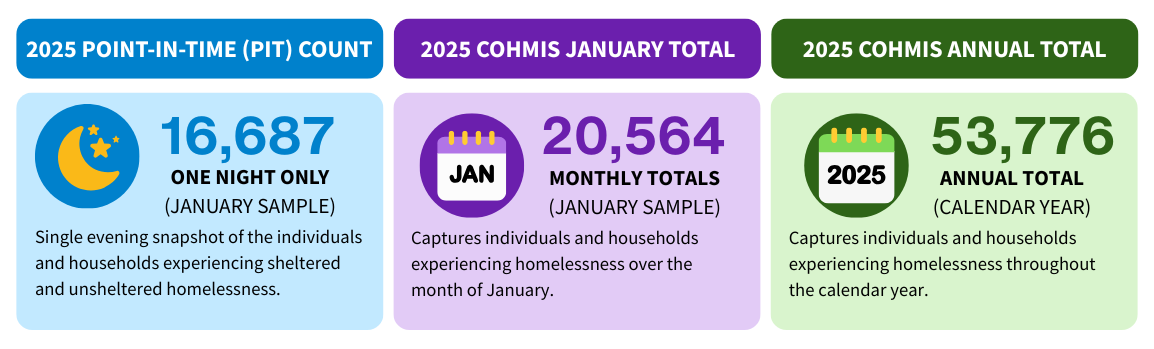
Homelessness is a fluid experience where people move through different parts of the system over time. To reflect that reality, this report draws primarily on COHMIS data to show how the system responds to ongoing need, utilizing the Point-in-Time (PIT) Count for additional context.
Each Data Source in Context ↓
COHMIS Data
A Year-Round View: A statewide database that captures engagement across the homelessness response system throughout the year.
The Method: Tracks demographics, service use, and housing outcomes for individuals and families as they interact with programs.
The Use: Provides the most comprehensive picture of how the system is responding to need over time.
Point-in-Time (PIT) Count
A Single-Night Snapshot: Mandated by the U.S. Department of Housing and Urban Development (HUD) and conducted each January.
The Method: Volunteers count people staying in sheltered settings, as well as those experiencing unsheltered homelessness in places not meant for human habitation.
The Use: Provides a high-level snapshot of how many people are experiencing homelessness on a single night each year.
Together, COHMIS and PIT offer complementary data points on homelessness—COHMIS providing a comprehensive, year-round view of how people engage with the system, while the PIT count offers a single-night snapshot for context. By looking beyond a single-night snapshot to the total population served, the infographic below highlights how the full scope of need—and the system’s impact—becomes more visible over time through COHMIS data.
C. Understanding Key Terms & Program Types
The following terms are used throughout this report and illustrate how individuals navigate the broader housing continuum, from immediate crisis through long-term stability.
Population Definitions
Total Served: Everyone who interacted with the homelessness response system during the year—from people experiencing unsheltered homelessness and engaging with street outreach, to those staying in emergency shelter, to households seeking prevention assistance, to those in permanent housing.
Experiencing Homelessness: A subset of the total served population, this refers specifically to people who, based on available data, experienced sheltered or unsheltered homelessness at some point in 2025.
Program Types
Crisis Response, Emergency Shelter, and Temporary Housing: Programs serving people currently experiencing homelessness who need immediate safety and stabilization.
Street Outreach: Engages people experiencing unsheltered homelessness where they are, providing basic survival needs and connections to shelter, services, and housing.
Emergency Shelter: Provides temporary, overnight accommodations often with other services including meals and case management.
Temporary Housing (Transitional Housing & Safe Haven): Offers short- to medium-term housing paired with supportive services to help people move toward stability.
Access & Support Services: Programs supporting people in crisis and at risk of homelessness by connecting them to resources across the system.
Coordinated Entry (CE): The primary access point for housing resources, assessing needs and prioritizing referrals for those resources.
Supportive Services: A broad range of supports serving people experiencing homelessness and those working to maintain housing. This includes case management, primary and behavioral healthcare services, employment assistance, meals, and other services to meet basic needs.
Permanent Housing & Prevention: Permanent housing is the most evidence-based tool for long-term stability, while prevention is essential for reducing the flow of households into the crisis system.
Permanent Housing: Long-term solutions supporting sustained stability, including:
Permanent Supportive Housing (PSH): Long-term housing with ongoing supportive services for individuals with disabling conditions or acute needs who have experienced chronic or repeated homelessness.
Rapid Re-Housing (RRH): Short- to medium-term rental assistance and services to help people quickly exit homelessness.
Other Permanent Housing (OPH): Long-term housing options that may include one-time, short-term, or long-term rental payment assistance with or without ongoing services.
Homelessness Prevention: Short-term financial assistance and services for households at risk of losing housing.
→ Community Highlights: Breaking Down Barriers to Housing
Across Colorado, partners are working together to remove real-world barriers that can prevent people from accessing housing.
Pets and Housing Access:
For many, pets are a critical source of stability but can become a barrier in traditional housing and sheltering systems. In Boulder County, Annie and Millie’s Place, in partnership with outreach teams, housing providers, and veterinary partners, like The Street Dog Coalition & Veterinary Emergency Group, helps ensure individuals can enter housing without being separated from their pets. When Maria’s dog, Luna, was injured while they were staying in temporary housing, partners quickly coordinated care. Annie and Millie’s Place arranged an emergency veterinary visit, ensuring Luna received treatment so Maria could continue focusing on her path toward stable housing.
This same commitment to keeping people and their pets together has also taken shape in Mesa County, where HomewardBound of the Grand Valley and the Roice-Hurst Humane Society operated the Homeward Hounds initiative—offering pet-friendly shelter so individuals did not have to choose between their safety and staying with their animals. Over five years, the program supported approximately 300 unhoused individuals and their pets. While the program has since ended following the closure of the shelter where it operated, it reflects a shared, community-driven approach to removing barriers and supporting pathways to stable housing. Together, these efforts demonstrate how pet-inclusive solutions can expand access to care and housing.
Responding to People’s Needs:
In another case, David, a medically vulnerable individual, initially refused urgent care because he feared losing his belongings. Through coordination across HOPE for Longmont (outreach services), LEAD (a diversion and case management program for individuals involved in the justice system), and CORE (a co-response team supporting individuals in crisis), partners were able to secure and store his belongings, build trust, and connect him to urgent medical care.
With those immediate needs addressed, they continued working together to identify a housing option that would support his long-term stability.
By aligning across partners, the system is adapting to people, not the other way around.
Understanding Who the System Serves
A. Purpose & Framing the Population
Colorado’s response system supports a broad spectrum of housing and prevention needs. To understand the scale of this work, it's important to distinguish between two overlapping groups:
People Experiencing Homelessness: Despite increased economic pressure, the number of individuals actively experiencing homelessness fell to 53,776, a 0.7% decrease that underscores the effectiveness of current housing strategies and programs.
People Needing Resources: In 2025, we provided services to 84,425 total people, a 3.7% increase that reflects our expanded efforts to catch households before they fall into crisis and with supports successfully staying housed.
Members of the Balance of State Lived Experience Advisory Board emphasize a critical system reality:
“Keeping people housed is the least expensive way to fight homelessness.”
This principle underscores the importance of the data found throughout this report.
Lived Experience & System Impact
While system-level data provides important insight, it does not fully capture how individuals experience homelessness or navigate the response system.
Throughout this report, perspectives from people with lived experience and system impact highlights are included to:
Provide insight into how systems are working in practice
Highlight barriers and gaps that may not be visible in the data
Inform more effective and person-centered solutions
Note: Lived experience perspectives are intended to complement the data and ensure that the report reflects both system performance and real experiences.
B. Who is Being Served
The homelessness response system serves a diverse population across household types and life stages, including single adults, families with children, youth and young adults, older adults, veterans, and people experiencing chronic homelessness. The dashboards and sections that follow use COHMIS data to explore how these groups are represented across the system and highlight what the data shows.
Youth and Young Adults (Ages 24 and Under):
Youth and young adults are experiencing the most rapid proportional growth across the entire system. While they represent a smaller share of the total population, the double-digit increases seen in 2025 signal a growing crisis that requires targeted intervention.
What the data shows:
Youth homelessness increased by 10.3%, while the total number of youth served grew by 15.3% compared to 2024.
This trend is driven by a combination of rising economic barriers, family conflict, and the transition out of systems like foster care or juvenile justice. As affordable housing becomes harder to secure, young people are increasingly vulnerable to housing instability.
Part of this increase is also a success of the system: Expanded outreach and youth-focused resources, including projects funded through the Youth Homelessness Demonstration Program (YHDP), have improved Colorado’s ability to identify and support young people who were previously undercounted.
Early intervention matters. Without timely support, youth experiencing homelessness face severe barriers to education and employment. Connecting youth to the system early is the most effective way to prevent long-term, chronic homelessness in adulthood.
Families with Children:
Families also represent a growing segment of those seeking support, with a notable shift toward the success of early intervention. While the number of families experiencing homelessness rose by 6.0%, the total number of families served by the system increased by 12.1%.
What the data shows:
This data highlights a major system success: Colorado is reaching families earlier. Families now represent 37.6% of all persons served, and they make up the vast majority (69.2%) of households in homelessness prevention programs.
The increase in families seeking help reflects statewide economic strain, including rising rents and a critical shortage of family-sized affordable housing units.
Because even short periods of instability can affect a child’s health, education, and intellectual or emotional development, the system’s focus has shifted toward proactive support to ensure children stay in their homes and communities.
The Total Served view reveals that Colorado’s system is effectively acting as a buffer for families. By engaging them through supportive services and prevention, thousands of children have been protected from having to enter the emergency shelter system.
Overrepresented Groups Across the System:
Black, Indigenous, and People of Color (BIPOC) continue to be overrepresented among those experiencing homelessness and those accessing services from Colorado’s homelessness response system. To better understand and highlight these disparities, each group’s representation in COHMIS has been contrasted with their share of Colorado’s overall population using statewide population data from the Vintage 2024 Census Population Estimates Program (PEP) prepared by the Colorado Statewide Demography Office.
What the data shows:
Several groups are overrepresented within the system, including Native Hawaiian or Pacific Islander (5.5x more represented), Black, African American, or African (3.4x more), American Indian, Alaska Native, or Indigenous (2.7x), Two or More Races (1.5x), and Hispanic/Latina/o residents (1.3x).
These disparities are especially stark for Black residents, who make up about 5.0% of Colorado’s population but 17.0% of those experiencing homelessness and 17.6% of all people served.
American Indian, Alaska Native, Indigenous, and Native Hawaiian or Pacific Islander residents also remain significantly overrepresented, reflecting persistent inequities in housing access and stability.
While disparities exist statewide, their scale and composition vary by region. Each Continuum of Care reflects different patterns of overrepresentation, underscoring the need for locally informed, data-driven responses.
Older Adults (Ages 62 and Older):
As Colorado’s population ages, a growing number of older adults are expected to enter the homelessness response system for the first time in their lives. Driven by fixed incomes that cannot keep pace with rising rents and medical costs, this demographic faces a unique "double burden" of housing instability and declining health. Reporting from a 2025 Colorado Sun article titled “Aging with nowhere to go: Increasing number of people age 65 and older are becoming homeless in Colorado” underscores this shift, highlighting how the intersection of a high-cost housing market and a lack of specialized senior care is driving record numbers of older Coloradans toward the crisis system.
Rising utilities and housing costs are pushing seniors—many of whom have been stable for decades—into crisis.
Our current emergency shelter infrastructure was not originally designed for the complex needs of older adults.
Many seniors require assistance with Activities of Daily Living (ADLs) such as medication management, bathing, and mobility support.
Cognitive Needs: Increasing rates of cognitive decline require specialized, low-stress environments that standard congregate shelter settings cannot always provide.
Perhaps more than any other demographic, older adults highlight the urgent reality that housing is healthcare. Success for this group means moving beyond a bed in a shelter toward a permanent home that can accommodate their changing physical and health needs.
Together, household type, patterns of overrepresentation, and age help paint a picture of who is being served across the system, while population characteristics—including veteran status, disability, and experiences of long-term homelessness—provide a deeper view into the needs of those served. The dashboard below highlights these characteristics, with the following sections exploring trends among these groups.
Veterans:
Veterans remain a priority population within Colorado’s homelessness response system, serving as a powerful example of how targeted, data-driven strategies yield meaningful results.
What the data shows:
In 2025, the number of Veterans experiencing homelessness decreased by 2.9% (falling from 3,429 to 3,330).
Simultaneously, the total number of Veterans served by the system increased by 3.4% (reaching 6,264). This indicates that our "front door" is wider than ever, connecting more Veterans to supportive services and prevention before they reach a point of crisis.
These outcomes are not accidental. They are the result of sustained investment, coordinated systems, and strong partnerships, particularly with the U.S. Department of Veterans Affairs and local VA teams across Colorado, who play a critical role in aligning housing resources, healthcare, and case management.
The progress seen among Veterans offers a clear insight for the broader system. When communities have access to dedicated resources, shared data, and coordinated pathways to housing, reductions in homelessness are not just possible but obtainable. Expanding these conditions across other populations, including families, youth, and single adults, represents a key opportunity to drive similar progress statewide.
Chronic Homelessness & Disabling Conditions:
While progress among Veterans is notable, data for 2025 shows a growing need among those with complex health challenges and long-term instability.
An individual is considered chronically homeless if they have a documented disabling condition and have either been continuously homeless for at least one year or have experienced four or more episodes of homelessness totaling at least 12 months in the last three years.
What the data shows:
The number of people with a reported disabling condition served by the system grew to 39,492 (+4.6%), representing 47% of all people served and 55% of those experiencing homelessness.
Individuals experiencing chronic homelessness increased by 3.8% statewide. This growth reflects the ongoing challenge of a housing market that lacks enough Permanent Supportive Housing (PSH) units to support those with the most intensive support needs, who often require long-term housing paired with ongoing supportive services.
Trends in chronic homelessness are not uniform across the state and are closely tied to local capacity and resource alignment. PSH is specifically designed to move people experiencing chronic homelessness off the streets and into stable housing with ongoing support. In Northern Colorado, the opening of the Star Rise PSH project corresponded with a measurable decline in chronic homelessness—demonstrating that when these resources are brought online, they function as intended. Similar declines were reported in Pikes Peak, while Metro Denver and the Balance of State saw increases, underscoring gaps in available resources. These variations highlight that while targeted investments like PSH can drive reductions in chronic homelessness, scaling resources to meet the full scope of need—and expanding additional pathways out of homelessness—is essential to sustain and accelerate these trends statewide.
Contributing & Regional Factors
A. Contributing Factors
While Colorado’s homelessness response system is performing, it does not operate in a vacuum. Three primary forces continue to drive inflow and create barriers to stability.
The Housing Affordability Gap: Housing affordability remains the primary driver of homelessness. A statewide shortage of affordable and family-sized units creates a "bottleneck," making it difficult for individuals to exit the system even when they have a housing voucher in hand.
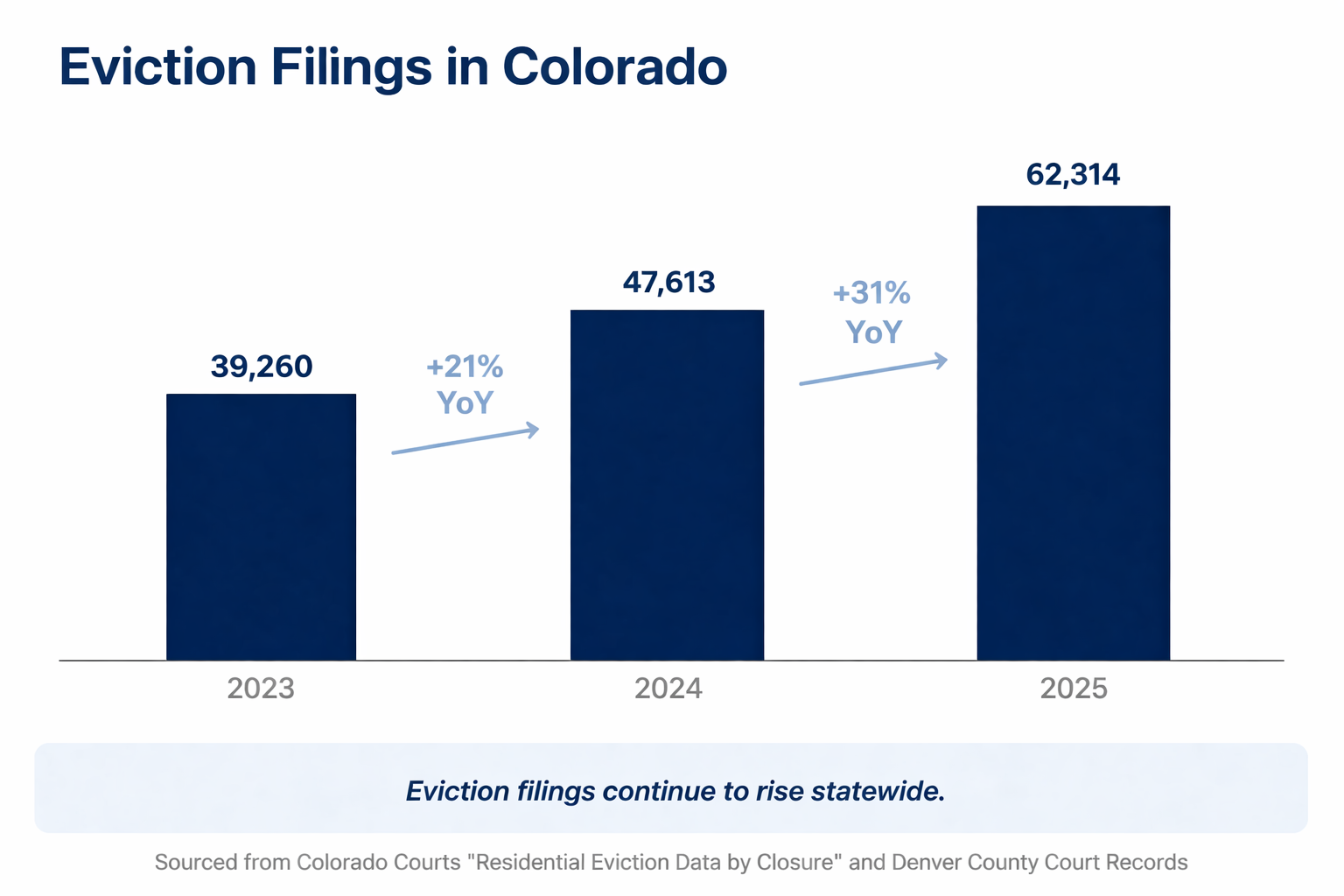
Rising Eviction Pressures: Rising eviction filings in 2025 are a direct contributor to system inflow. This economic pressure is pushing families and individuals into the response system for the first time, often overwhelming emergency resources. Evictions are often the result of the inability to pay rent or rent increases that are outpacing wage growth.
Intersecting Health Barriers: For low-income Coloradans with physical disabilities, mental health challenges, and/or substance use disorders, securing and maintaining safe, stable housing can be a challenge. Permanent Supportive Housing (PSH) pairs affordable housing with access to intensive coordinated supportive services to help persons with histories of homelessness and complex barriers to housing stability live independently with improved health outcomes and reduced emergency system utilization.
→ Community Highlight: From Collaboration to Housing Outcomes
Building Coordinated Entry and Housing Access in Southeast Colorado
In Southeast Colorado, the Balance of State Continuum of Care and the regional coalition Yielding Equitable Entry to Housing and Wellbeing (YEEHAW) partnered to build and implement a Coordinated Entry System (CES) in the region for the first time. Alongside training and onboarding providers into COHMIS and strengthening data quality, these efforts helped house 30 individuals in Permanent Supportive Housing (PSH) in Rocky Ford.
These outcomes reflect a strong community commitment to collaboration, support for unhoused neighbors, and the effective use of COHMIS and Coordinated Entry.
B. Regional Variation and System Context:
Homelessness looks different across Colorado’s diverse landscapes. The regional data in this report reflects variations in local housing markets, service infrastructure, and geographic realities.
Infrastructure & Scale: Larger metro areas possess a denser network of specialized services, while rural and frontier communities often operate with leaner infrastructure where a single provider may cover multiple counties. Mid-sized regions often fall between these extremes— operating more robust systems than rural areas, but without the scale or specialized housing inventory found in large metro regions.
Inventory & Outflow: The ability to exit the system is closely tied to local housing market conditions. In larger metro areas, more housing exists, but high demand, rising rents, and competition can make it difficult to secure a unit, even with assistance. In mid-sized regions, limited inventory and low vacancy rates continue to slow exits from the system. In rural and frontier communities, a severe shortage of rental housing creates challenges for any program relying on rental assistance, from Rapid Re-Housing (RRH) to other voucher-based permanent housing programs, even when funding is available. Permanent Supportive Housing (PSH) is often limited or unavailable in these areas, further restricting options for people with the most intensive needs.
Geographic Barriers: In Colorado’s frontier areas, the distance between services and a lack of reliable transportation are significant hurdles. In these regions, street outreach teams must often travel hundreds of miles to connect a single household to the system. Mid-size regional systems face a different set of geographic challenges, where services may be concentrated in key population centers, requiring households from surrounding communities to travel significant distances to access shelter or supportive services. In larger metro areas, geographic barriers are less about distance and more about navigation and access of services.
→ Community Highlights: Regional Collaboration in Mesa County
Strengthening the Response System in Grand Junction
The Mesa County Collaborative for the Unhoused (MCCUH) is a community-driven initiative focused on reducing the harms of homelessness in ways that benefit everyone in Grand Junction. Through a community-wide Unhoused Strategy & Implementation Plan—adopted by the City of Grand Junction, the Grand Valley Coalition for the Homeless, and MCCUH—the community is working to address critical gaps and meet the immediate needs of individuals experiencing homelessness in the area. This shared commitment has led to the formation of working groups that have supported onboarding new providers into COHMIS, strengthening coordinated entry, and establishing a comprehensive lived experience workgroup.
Neighbor 2 Neighbor Street Mobile Outreach
The Grand Junction Housing Division's Neighbor 2 Neighbor Street Mobile Outreach team demonstrates how empowering leaders with lived expertise creates more effective systems. Led by Sherry Price (City of Grand Junction), Philip Masters (United Way of Mesa County), and Nathan Jewkes (Peer 180 Recovery), the team provides essential gear, first aid, and housing referrals to those living unsheltered.
By leveraging their past personal lived experience, Philip and Nathan build trust and open lines of communication that are often inaccessible to traditional providers. Their leadership has significantly expanded the reach and effectiveness of the unsheltered response in the Grand Valley, proving that real-world solutions are most impactful when shaped by those who have navigated the system themselves.
How the System is Responding & Performing
A. System Performance: A Dynamic System
Homelessness in Colorado is not a static problem—it is a dynamic challenge met by an increasingly effective system. While external economic factors have increased the number of people seeking support, our state's response system is performing at a high level. This is reflected in housing outcomes across the system, from prevention to housing stability and exits to housing.
Spotlight: The Impact of Permanent Housing
While the broader homelessness response system provides essential crisis services, Permanent Housing (PH) programs represent the state's most effective tool for long-term resolution. The 2025 data confirms, what decades of evidence have shown, that once individuals are placed in stable housing with appropriate supports, they overwhelmingly remain housed.
Housing Outcomes Review (2025)
Of the 17,468 people served in PH projects this year, 82.1% were successfully housed.
Permanent Supportive Housing continues to lead in retention. On a monthly basis, 94.9% of PSH participants remained stably housed—demonstrating that even those with the most complex needs can succeed when given the right support.
Permanent Housing: Strong Outcomes, Limited Supply
Permanent Housing programs are working exactly as intended. Once people are connected to stable housing with the right supports, they overwhelmingly remain housed. At the same time, the system is seeing roughly 1,450 people experiencing homelessness enter for the first time each month, while only about 575 enter Permanent Housing programs. This creates a widening gap between what is working and what is available, highlighting the need to expand access to Permanent Housing so more individuals can move from crisis to stability.
→ Community Highlight: Using System Modeling to Strengthen Northern Colorado’s Response
As the data shows, Permanent Supportive Housing (PSH) remains one of the most effective interventions in the homelessness response system, delivering strong housing stability outcomes for households with the most complex needs. However, the demand for PSH resources in Colorado far exceeds the limited supply of available opportunities. As a result, communities must not only expand housing inventory, but also identify additional pathways that help people resolve housing crises earlier—before they reach chronic levels of need.
In Northern Colorado, both Larimer and Weld County are using system modeling to better understand how people move through the homelessness response system to identify opportunities for earlier, effective intervention. By analyzing inflow, outflow, and program capacity across interventions like prevention, Rapid Re-Housing (RRH), and Permanent Supportive Housing (PSH), communities can pinpoint where bottlenecks occur and where earlier investments could reduce pressure on limited housing resources. This approach helps illuminate how strengthening upstream interventions—such as prevention and diversion—can reduce the number of people progressing to chronic homelessness, while also improving overall system flow. By building on COHMIS data, system modeling enables communities to move beyond measuring outcomes to actively designing a more efficient, balanced system that maximizes the impact of every available resource.
B. The Role of Prevention
Homelessness prevention programs serve households at risk of losing housing, often before they experience homelessness. By helping people remain housed, these efforts reduce inflow into the homelessness response system and allow resources to be more effectively directed toward those already experiencing homelessness.
Prevention plays a critical role in reducing the number of people entering homelessness and easing pressure on the system overall. However, across Colorado, rising housing costs and financial instability continue to put more households at risk of losing their housing. Recent data from the Colorado Judicial Department’s 2024 "Eviction Legal Defense Fund Five-Year Evaluation" shows that nonpayment of rent is the leading cause of eviction in the state.
Eviction Trends:
Data from the Colorado Courts “Residential Eviction Data by Closure”, and Denver County Court records shows a sharp increase in eviction filings, from 39,620 cases in 2023 to 47,613 in 2024, and then surged by over 30% to approximately 62,134 cases in 2025. This continued increase we see in the data highlights the growing number of households experiencing instability and underscores the importance of prevention efforts.
It is also important to note that formal eviction filings only represent those who are formally requested to leave. Some households may leave housing situations, or “self-evict”, prior to a formal court filing or displacement in order to avoid legal consequences or escalate instability. As a result, actual housing loss and near-loss may be higher than what the eviction court data reflects alone.
Homelessness Prevention Data:
Homelessness prevention data in COHMIS reflects support provided to households at imminent risk of losing housing and entering the cycle of homelessness. While most participants are not experiencing homelessness at enrollment, these interventions play a critical role in stabilizing households and reducing inflow into the homelessness response system.
In 2025, homelessness prevention projects in COHMIS served 11,748 people statewide, a 7.8% increase from 2024, reflecting continued expansion of prevention efforts.
An average of 4,190 people are served each month, with nearly 400 exiting to housing monthly; 74% of all exits result in housing, demonstrating strong stabilization outcomes.
The population served is largely family-centered, with nearly 70% in households with children and 39% of participants under age 18.
As of year-end, 4,299 people remained actively enrolled in prevention projects, reflecting ongoing support to households working to maintain housing stability.
→ Community Highlight: Promising Ways Forward in Prevention
In February 2026, the Metro Denver Homeless Initiative (MDHI), in partnership with the City and County of Denver and Adams County, was selected as one of only 10 pilot sites nationwide for Right at Home—a national initiative aimed at stopping homelessness before it starts.
This partnership represents a major shift toward upstream intervention in Colorado. By participating in this national pilot, Metro Denver is not only securing millions in new funding but is also helping to build a rigorous, data-driven case for prevention as a primary solution to the housing crisis.
Based on Destination: Home's successful strategy from Santa Clara County, CA, the program provides rapid, flexible financial assistance and case management to households on the brink of housing loss. National data indicates that 90% of participating households remain stably housed two years after receiving assistance.
With a $425,000 planning grant and $5M in anticipated implementation funding, this pilot aims to stabilize households and collect needed data to scale prevention.
This work will build on the eviction prevention work being done across Colorado through programs like the State’s Colorado Emergency Rental Assistance Program and Denver’s Temporary Rental and Utility Assistance Program, which provides rapid emergency assistance payments to renters facing eviction.
C. Progress and Ongoing Challenges
Investments in prevention have supported households across the state, but there is still significant work to be done to meet the growing needs of Coloradans.
During the COVID-19 pandemic, Colorado received over $689 million in federal Emergency Rental Assistance funding, assisting more than 57,500 households facing eviction.
As federal funding has wound down, the state has continued these efforts through the Colorado Emergency Rental Assistance (CERA) program, which is expected to serve over 2,800 households annually.
In 2023, the Division of Housing awarded over $14.6M in Transformational Homelessness Response grants for eviction and homeless prevention activities. These grants began in January 2024 and will support over 4,000 individuals through September 2026. Since these awards began over 4,355 people have already received assistance.
In 2025, the Division of Housing awarded over $1.5M for homelessness prevention activities through the Homelessness Resolution Program. These awards are made on an annual basis.
Additional investments, including eviction legal defense funding, homelessness prevention grants, and strategic planning have collectively supported tens of thousands of households in maintaining housing stability.
Even with these investments over the last six years, demand for resources far exceeds what is available. Currently, the Colorado Emergency Rental Assistance Program is only able to select between 7% to 13% of applicants who apply each month for funding, leaving an unmet need for Coloradans at imminent threat of eviction or displacement.
At the same time, prevention can be more difficult to measure than other parts of the system. Success is often not visible in homelessness counts, as it reflects situations where homelessness was avoided altogether. While Point-in-Time counts and annual service data capture those who experience homelessness, they do not fully capture the impact of households who are able to remain stably housed due to timely intervention.
Even with these limitations, prevention remains a key part of a comprehensive response. As eviction filings rise and more households face housing instability, prevention efforts play an essential role in reducing system inflow, stabilizing communities, and supporting long-term housing outcomes.
Across the state, communities are making progress in strengthening the homelessness response system and expanding access to housing and services.
Call to Action
The data in this report confirms a singular truth: Colorado’s homelessness response strategies are working, but they are currently operating at a fraction of the scale required to resolve the crisis. To build on the progress made in 2025, we must pivot from crisis management to sustained housing investment.
A. Prioritize and Expand Permanent Housing Options
The goal is to close the inventory gap across all types of permanent housing. Based on the 2025 Housing Inventory Count (HIC), Colorado has 16,118 permanent housing beds—far short of the scale needed to meet demand—including 8,102 for Permanent Supportive Housing (PSH), 2,876 for Rapid Re-Housing (RRH), and 5,140 for Other Permanent Housing (OPH).
For individuals experiencing chronic homelessness, PSH provides the long-term housing and ongoing support needed to achieve stability. At the same time, RRH and OPH serve as critical pathways for others, offering shorter-term assistance or longer-term housing options that help people move out of crisis settings and into stable housing.
Across all permanent housing types, capacity is constrained by a lack of available, affordable housing. Without sufficient inventory, individuals remain in emergency shelter or unsheltered situations longer than necessary, not due to a lack of readiness, but due to a lack of housing options. Expanding permanent housing capacity across all housing types is essential to ensure timely exits from homelessness and sustained housing stability.
B. Protect Existing Housing
Of the 17,468 people served in permanent housing programs, 82.1% remained housed or exited to housing, including 11,114 who were actively enrolled and housed at the end of 2025.
Any reduction in funding or support services puts these individuals at immediate risk of returning to homelessness—effectively undoing years of progress and increasing the burden on crisis systems.
C. Expand Prevention and Early Intervention to Stem the Inflow
Reducing the number of people experiencing homelessness is best accomplished by preventing it before it begins.
As seen in our family data, 69.2% of those in prevention programs are families with children. Expanding these upstream interventions, such as emergency rental assistance and legal aid, prevents the trauma of displacement.
It is significantly more affordable to keep a household in their current home through a one-time grant than to re-house them after they have entered the emergency shelter system.
It is important that Colorado communities invest in housing problem solving strategies that intervene earlier and resolve crises faster. By strengthening diversion and prevention efforts, communities can help households identify immediate, flexible pathways out of homelessness, reducing inflow and preserving limited housing resources for those with the highest needs.
In 2025, 27,448 people achieved or maintained housing stability across the system, including individuals and families supported through homelessness prevention programs, those actively stabilized in permanent housing, and those exiting to housing from their most recent enrollment.
Taken together, COHMIS data provides a more complete picture of system performance, showing not only who is being served, but also which strategies are effectively supporting housing stability and where continued investment is needed.
These outcomes reinforce a clear point: homelessness is not an inevitable consequence of Colorado’s growth, but a solvable crisis driven by a widening gap between housing costs and available inventory. When communities invest in permanent housing, strengthen prevention, and coordinate across systems, the response system succeeds in helping ensure that homelessness is rare, brief, and non-recurring.